
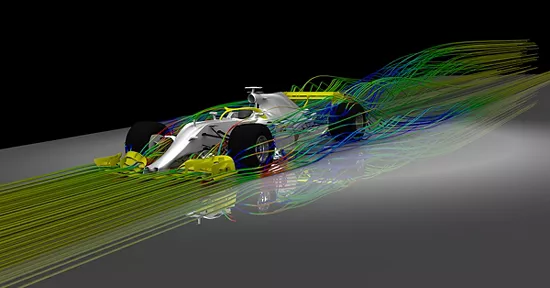
Constructing a STEM Racing World Finals racecar isn’t just about putting parts together and hoping for the best on track day—it’s about knowing exactly how every millimeter of the car will behave before it even starts being constructed. In the world of STEM racing, two digital tools serve as our absolute backbone for virtual testing: Computational Fluid Dynamics (CFD) and Finite Element Analysis (FEA). CFD is a branch of fluid mechanics that uses numerical analysis and data structures to simulate how air flows around our racecar.
Why CFD matters to us:
- It serves as an identification tool for inefficient parts of the car, causing unwanted drag.
- CFD helps the engineering department map air streamlines, ensuring clean airflow around key components.
FEA is a computerized method for predicting how a physical component reacts to real-world forces, vibration, heat, and structural loads. In STEM Racing, every gram of unnecessary weight is a penalty, but structural failure means a total race collapse. FEA gives us the confidence to push structural boundaries.
Why FEA analysis matters to us:
- Mass optimization by removing excess weight without sacrificing the structural stability of the car.
- FEA helps engineers locate the most vulnerable spots of a car under high pressure.
- Via FEA analysis, engineers are given the chance to test different materials and how they behave in different conditions, thus allowing engineers to choose the most efficient materials for the construction of our racecar.
- Stay tuned as our engineering team steps into the lab, ready to turn those virtual simulations into a reality.

