Before a single piece of metal is cut or a single bolt is tightened, our race car takes shape in the digital realm. Building a competitive vehicle is a monumental task that demands precision, rapid iteration, and seamless collaboration. To turn raw ideas into a race-ready machine, our team relies on a robust software stack that acts as the backbone of our engineering and daily operations.
The core of our design process relies on a combination of heavy-hitting CAD (Computer-Aided Design) platforms. We use SolidWorks and Autodesk Fusion 360 as our primary workhorses. SolidWorks handles our complex parametric modeling and major structural assemblies, ensuring every component fits perfectly within the overall packaging of the car. When it is time to transition from the screen to the workshop, Fusion 360 bridges the gap by generating the precise CAM (Computer-Aided Manufacturing) toolpaths we need to CNC-machine our custom parts.
However, engineering is a collaborative sport, which is why we also heavily integrate Onshape into our workflow. Because Onshape is cloud-native, multiple sub-teams can work simultaneously on modular subsystems without stepping on each other’s toes or dealing with locked files. It is our go-to platform for rapid prototyping, designing brackets, and allowing team members to iterate on designs from anywhere, whether they are in the lab or at home.
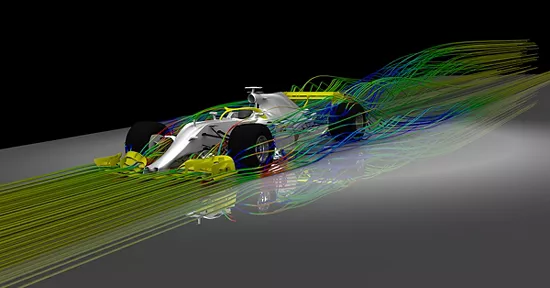
Of course, drawing a part is only half the battle; we also need to know it will survive the extreme conditions of race day. That is where Ansys comes in. By running high-fidelity simulation software for both Computational Fluid Dynamics (CFD) and Finite Element Analysis (FEA), we can virtually test our designs before wasting any physical material. Ansys allows us to map airflow over our aero package to minimize drag, while also verifying that critical, load-bearing suspension components will withstand peak cornering forces.
Managing hundreds of complex CAD files and simulation reports could easily become a logistical nightmare. Rather than overcomplicating our workflow with bulky enterprise software, we keep our version control and team organization lean, fast, and universally accessible using the Google Workspace.
Google Drive serves as our central version control hub. We enforce strict folder architectures and standardized file-naming conventions (such as Subsystem_PartName_Rev#_Status) to guarantee that an outdated CAD file never accidentally makes it to the manufacturing floor. Meanwhile, live Google Sheets house our dynamic bill of materials (BOM), budgets, and manufacturing logs, keeping everyone aligned during chaotic build sessions. Paired with Google Calendar and Meet to synchronize our design reviews and scrutineering deadlines, the suite keeps our operations running smoothly.
Ultimately, integrating powerful simulation and design tools with straightforward operational software lets us spend less time troubleshooting our digital workflow and more time doing what matters most: shaving tenths of a second off our lap times.